Interview Preparations
For my third interview I didn't change very much. I had the same recorder, the same set of questions (even though I did want to change them, I never did get around to it). My interviewee was a classmate, Ibrahim, who was nice enough to volunteer to be interviewed even though it's so close to finals.
We had planned to the interview in the library, but for some reason there were a lot of people all over, and no real space where we wouldn't be disturbing anyone. So we went to Caribou and did the interview there.
Transcript
I chose not to transcribe this interview. There was too much that couldn't be heard over the background noise in the recording, so it would have definitely been my weakest transcription.
Personal Review
In retrospect, it was a bit of a mistake to do the interview at Caribou. I didn't realize how noisy it was over there, and how much background noise and talking my recorder would pick up. Even after the interview I thought it would be fine, but when I was listening to the recording to try and transcribe it, I found out that wasn't really the case.
The interview itself went fine, though. My interviewee seemed comfortable and was willing to give a lot of detailed information about Saudi Arabia and its culture. Unfortunately, since I hadn't changed my questions, I still had a few questions that didn't serve much of a purpose.
Country Report
Saudi Arabia is a large country in the middle east. It is a monarchy where approximately 97% of the population practices Islam. The official language of Saudi Arabia is Arabic, but other languages such as Tagalog and Urdu are spoken in some parts of the country. The climate is a desert climate, and the country is known for being one of the largest exporters of petroleum.
(Information in country report taken from http://en.wikipedia.org/wiki/Saudi_Arabia. Accessed 4/24/2011.)
Saturday, April 23, 2011

Tuesday, April 5, 2011
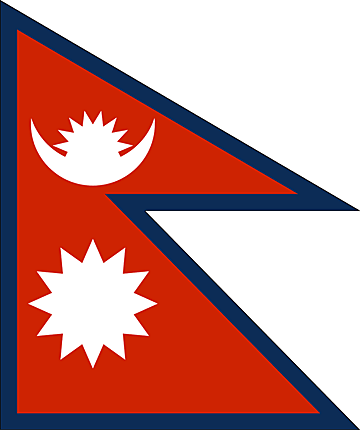
Country Report (Nepal+Sri Lanka)
Group Members
Asif Hussain
Alexandra Holker
Maggie Schwagel
Kim Siemsen


Asif Hussain
Alexandra Holker
Maggie Schwagel
Kim Siemsen
Nepal Sri Lanka
Library at Tri-Chandra College Tamil College, Northern Sri Lanka
Kathmandu, Nepal
Outline
A. Culture
1. Government
a. Development of government in Nepal
b. Corruptive government in Sri Lanka
2. Religion
a. Main religions in Nepal
b. Main religions in Sri Lanka
B. Education
1. Reasons for studying in the U.S.
a. Lack of facilities and free choice in Sri Lanka
b. No hands-on learning and poor quality facilities in Nepal
2. Educational facilities in home country
a. Two different types of schooling systems in Sri Lanka
b. No government funding in Nepal
C. Social
1. Food
a. More flavor and ingredients
b. Preference of home countries’ food
2. Family life
a. Strong family ties
b. Keeping in contact with home
Sunday, April 3, 2011
My Second Interview
Interview Preparations
Finding a person to interview was easy again this time, because my first interviewee had a sister who was willing to be interviewed. Her name is Stephnie Fernando. Unfortunately, I had some difficulty getting in contact with her because our schedules are extremely conflicting and I didn't know her phone number or email address. I ended up talking to her while she was at work (which felt very awkward for me, but at least no customers were around so it's not like I was getting in the way of anything) and we decided on a time to actually do the interview.
I still had the same recorder from before. I had altered my questions a bit based on my first interview, but looking back on it, there were still some questions I should have removed and some I should have added. We did the interview in the UPB office, which was perfect at the moment because most of the people in UPB were at a conference, so it was very quiet.
Transcript
M: Why did you decide to come to SCSU instead of studying or working in your own country?
S: First, I went to an international school. All the universities back home are government-run and they all do it in Sinhala medium. And the other thing is my sister was already enrolled in this university, so my parents thought of sending me here. And... working in my country, there are not many jobs for international school students, especially if we cannot get the degree there. So I decided to come here.
M: I heard that in Sri Lanka the government chooses your major for you and that you don't really have a choice. Is that true?
S: I'm not sure about the universities, but in high school and everything... for the international school students, we can choose if we want to do commerce, science or arts. There's three different areas where we can concentrate. But for those who go to the government schools, it all depends on how well you do in elementary school and high school and then they decide which side you should follow.
M: What did you think of the US before coming here and how have your thoughts changed?
S: Before coming here I didn't have much of an idea. All I knew was that my sister was here and that I was going to live in an apartment. I knew I would be dealing with all white people. I didn't know that there were going to be a lot of Sri Lankans here. There were about more than 20 Sri Lankans in this university when I came here. And the Fall was really nice -- I came here during the Fall. It was really nice, and... I simply don't like the Winter; it's too long.
M: Is it really cold for you?
S: Yeah, it is.
M: How cold does it usually get in Sri Lanka?
S: Sri Lanka is pretty warm. Usually it's 80 Fahrenheit. Sometimes it goes to 60s, but... I don't think it goes below that. So this is VERY cold. Now it's sort of okay. Of course, wearing the proper clothes... And sometimes, like my first semester, I forget my jacket and I go running into the bus. I walk out of the apartment, and I suddenly realize I don't have my jacket on. But I'm not going to go upstairs again just to get the jacket.
M: What was the hardest thing about transitioning to the US?
S: The hardest thing was... I hadn't been with my sister for about 3 years when I first came here. And my sister and I used to be great friends, but when I came here she was... very matured, I guess, so... It was like I sort of missed my sister. She seemed to be a lot busy, and I missed my parents a lot because I hadn't been away from them before except maybe one night. So it was so difficult. I just wanted to go back home at that point.
M: Do you talk to your parents a lot still?
S: Yeah. We use Skype, it's free. So practically we speak every day. Sometimes if I won't be able to speak one day my parents are going to call my phone. They'll keep calling my phone because obviously they miss us too. And we don't get to go home very often. The ticket prices are about $2000. So it's like... no way.
M: That would be so hard, not being able to visit your family.
S: Yeah. And I know some people here get to go home at least once per three weeks and they still feel homesick. I just don't understand.
M: Have you had any experiences with racism since coming here?
S: Not really... I've not personally had any, but I've been in classes where they say when they get into the buses and if there's person with dark-colored skin sitting a white person wouldn't want to sit next to them. I'm told stuff like that but it's never been the case with me.
M: Have you lost proficiency in reading, writing, or speaking your native language since coming to the US?
S: Since I went to an international school, I'm not that good in my native language. Just like my sister. But I'm way better than my sister of course. I'm pretty good at speaking because here the Sri Lankans obviously speak in Sinhala, and even back home with my parents I spoke in Sinhala. Writing has been somewhat of an issue because at our school we just had one period for the whole week which was about 35 minutes long, so studying Sinhala for just 35 minutes wasn't helping me. I'm okay with writing, but not really fluent. If you were saying something or reading out something, I couldn't write at the rate you are reading. I could do that with English. And about reading... I'm somewhat okay in reading, but there are some specific words which I won't be able to read.
M: Did you have problems when you lived in Sri Lanka because of that?
S: Yes. We had to go to sunday school, and the sunday schools in Sri Lanka at the place where I lived were Sinhala medium and so I used to be the last person every time we had an exam. For one thing... I didn't have the books because almost all of them who went to the sunday schools were from the government schools, and they get the books for free. Since we went to international schools we don't get the books. So I didn't have a book to study and then I can't write at the pace that the professor is teaching. And I'm just bad. I was just bad at Sinhala.
M: What are some cultural differences between Sri Lanka and here?
S: Food. The food here is just either boiled or... I don't know fried? Maybe grilled? There are no spices at all. Now we make our own food. When I came here, my sister doesn't eat much spices either, so most of the days we ate macaroni. Macaroni. Macaroni. Macaroni. Back home we usually eat rice as a main meal, and here, uh... I guess pasta is more main for here than rice. Here, even in Garvey you wouldn't find rice. You'd probably find stir-fry.
M: So you miss your food. But you can cook it at home, right?
S: Yeah. Now I do cook, and now my fiance's with me too, both of us cook. But my sister's vegan now... so it's pretty difficult to cook for her differently. Overall it's fine. We have all this stuff to cook and I have a job so I can get whatever I want.
M: It's not hard to find any of the ingredients you need?
S: There are some shops that have spices. I don't think it's that hard. And now they've opened up a new place. It's called the Somali Shop. It's all Somali food and it's bringing in stuff from New York and selling spices, and there's a Vietnam store that has spices too.
M: It just seems so weird that the US is an exception with how they eat. Because there are so many other countries that use spices and stuff all the time, but we just... don't.
S: Yeah. Even in France, there are a lot of white people, but they have a lot of stores which sell spicy food or spices.
M: What religions are commonly practiced in your country?
S: Our country is a Buddhist country. So at least 70 to 80% are Buddhists. After Buddhism comes Christianity. And after that there's Hinduism and Islam. So there's four main religions. But Buddhism is the main one.
M: Do you keep up with your home country's news?
S: Um... yes! I'm not fond of listening to news, but... There's a cricket match at 3 AM Saturday morning tomorrow, we've booked the Atwood Theater, and we are all going to watch it. It's between Sri Lanka and India, we came to the finals. I'm not sure if you know what cricket is.
M: I have a vague idea.
S: Most people don't know what cricket is and when I say cricket they're always thinking about the insect. So, most of the Sri Lankans and the Indians are going to meet in the Atwood Theater at 3 AM, and we're going to watch the match and we're going to win the game. But other than that I don't really watch much news. Unless there's a tsunami or something big that's happening, I don't listen to the news much. Even when I was back home I didn't like listening to the news. It's too much information and I have other work to do.
M: Are there any differences in laws between your country and the US?
S: I know one difference is the drinking age. Here it's 21, and back home it's 18. So I was 18 when I came here, and I heard that the drinking age is 21... like you're counted as an adult when you're 21. I'm not a drinking person so I don't mind about it, but it's like... I AM an adult, I'm 18! But they want us to be 21. The other thing about laws is here we get cards for permits, and back home don't have the cards. Before the driving licence we don't have a permit; we just have a piece of paper. Just a big piece of paper. We just have it for about six months, and we have to get our driver's licence or keep renewing that piece of paper. Um... I'm not that good at laws.
M: That's okay. How is the public transportation system in Sri Lanka?
S: Ah, that's a good question. Here we have buses running... every half an hour? And here you don't put so many people on one bus. But there it's like... you can see people hanging on the footboard too. Doors never close in those buses, except for some inter-city buses which stop in few places like the expresses we have here. But other than that the buses get so crowded and they don't have a time, so sometimes you can keep standing in the bus stop for maybe 40 minutes and still the bus that you want isn't here. And sometimes they have like four buses at the same time going to the same place and they're all going on a race to see which one's going to pick up the most amount of people, so. We have a driver and a conductor. The conductor's the person who collects the money and the driver just drives. Whatever they earn for the profits, it's all going to be based on how many people they get into their buses. Like here I believe it's on the number of hours that you worked. Because of that, back home, it's a huge rush to get on the buses. And the roads are not as big as the highways here, so the roads get a lot of traffic. It's difficult to go from point A to point B. Most of the time if it's somewhere close by, we would rather walk.
M: So you don't have to deal with all of that traffic.
S: Yeah. It's way too much.
M: This is my last question. Do you think it will be easy to find a job after college?
S: In the US? I don't think so. Most of the jobs and internships ask if you are US citizens, so... There's just a few where they're okay with international students. I know Canada is a little less strict about hiring international students. If I go back home I'll probably find a job, but I don't want to go back home and work. Because we get paid really low. Like here I work at Pizza Hut, and I earn $130 a week, but if I go back home... One of my friends was working in a communication store, and he said his income for a month is 15000 rupees, which is going to be $150 per month. So I'm just earning $20 less than him per week. And he's not just working in a food store, he's working in a communcation store. So I don't want to go back home. I was born in France, so I'm trying to get my citizenship in France so I can go to any of the European countries. I hope it works, but I need to get a degree or diploma before I can do that.
Personal Review
I felt like this interview didn't go as well. At least 1/4 of my questions required knowledge of politics and current events, which my interviewee this time didn't really have (I'm not disappointed in her or anything, though; I'm no different). I thought of a few other questions to ask to make up for that, but I think I should have a couple of backup questions written down just in case for my next interview.
Other than that I think it went fine. She seemed comfortable and I did get a lot of new information despite the fact that she was my first interviewee's sister.
Country Report
Sri Lanka is a small country located south of India. Up until 1972 it was known as Ceylon. According to the July 2008 census, its population is approximately 21,324,791. Sinhalese and Tamil are the official languages of Sri Lanka. English is spoken by 10% of the population and is frequently used in education and government. Buddhism is practiced by 70% of Sri Lankans. Hinduism, Christianity, and Islam are the most commonly-practiced religions aside from Buddhism. Sri Lanka is known for its production and exportation of cinnamon, which is native to the country.
Information in Country Report was taken from Wikipedia (http://en.wikipedia.org/wiki/Sri_Lanka. Accessed April 3rd, 2011).
Finding a person to interview was easy again this time, because my first interviewee had a sister who was willing to be interviewed. Her name is Stephnie Fernando. Unfortunately, I had some difficulty getting in contact with her because our schedules are extremely conflicting and I didn't know her phone number or email address. I ended up talking to her while she was at work (which felt very awkward for me, but at least no customers were around so it's not like I was getting in the way of anything) and we decided on a time to actually do the interview.
I still had the same recorder from before. I had altered my questions a bit based on my first interview, but looking back on it, there were still some questions I should have removed and some I should have added. We did the interview in the UPB office, which was perfect at the moment because most of the people in UPB were at a conference, so it was very quiet.
Transcript
M: Why did you decide to come to SCSU instead of studying or working in your own country?
S: First, I went to an international school. All the universities back home are government-run and they all do it in Sinhala medium. And the other thing is my sister was already enrolled in this university, so my parents thought of sending me here. And... working in my country, there are not many jobs for international school students, especially if we cannot get the degree there. So I decided to come here.
M: I heard that in Sri Lanka the government chooses your major for you and that you don't really have a choice. Is that true?
S: I'm not sure about the universities, but in high school and everything... for the international school students, we can choose if we want to do commerce, science or arts. There's three different areas where we can concentrate. But for those who go to the government schools, it all depends on how well you do in elementary school and high school and then they decide which side you should follow.
M: What did you think of the US before coming here and how have your thoughts changed?
S: Before coming here I didn't have much of an idea. All I knew was that my sister was here and that I was going to live in an apartment. I knew I would be dealing with all white people. I didn't know that there were going to be a lot of Sri Lankans here. There were about more than 20 Sri Lankans in this university when I came here. And the Fall was really nice -- I came here during the Fall. It was really nice, and... I simply don't like the Winter; it's too long.
M: Is it really cold for you?
S: Yeah, it is.
M: How cold does it usually get in Sri Lanka?
S: Sri Lanka is pretty warm. Usually it's 80 Fahrenheit. Sometimes it goes to 60s, but... I don't think it goes below that. So this is VERY cold. Now it's sort of okay. Of course, wearing the proper clothes... And sometimes, like my first semester, I forget my jacket and I go running into the bus. I walk out of the apartment, and I suddenly realize I don't have my jacket on. But I'm not going to go upstairs again just to get the jacket.
M: What was the hardest thing about transitioning to the US?
S: The hardest thing was... I hadn't been with my sister for about 3 years when I first came here. And my sister and I used to be great friends, but when I came here she was... very matured, I guess, so... It was like I sort of missed my sister. She seemed to be a lot busy, and I missed my parents a lot because I hadn't been away from them before except maybe one night. So it was so difficult. I just wanted to go back home at that point.
M: Do you talk to your parents a lot still?
S: Yeah. We use Skype, it's free. So practically we speak every day. Sometimes if I won't be able to speak one day my parents are going to call my phone. They'll keep calling my phone because obviously they miss us too. And we don't get to go home very often. The ticket prices are about $2000. So it's like... no way.
M: That would be so hard, not being able to visit your family.
S: Yeah. And I know some people here get to go home at least once per three weeks and they still feel homesick. I just don't understand.
M: Have you had any experiences with racism since coming here?
S: Not really... I've not personally had any, but I've been in classes where they say when they get into the buses and if there's person with dark-colored skin sitting a white person wouldn't want to sit next to them. I'm told stuff like that but it's never been the case with me.
M: Have you lost proficiency in reading, writing, or speaking your native language since coming to the US?
S: Since I went to an international school, I'm not that good in my native language. Just like my sister. But I'm way better than my sister of course. I'm pretty good at speaking because here the Sri Lankans obviously speak in Sinhala, and even back home with my parents I spoke in Sinhala. Writing has been somewhat of an issue because at our school we just had one period for the whole week which was about 35 minutes long, so studying Sinhala for just 35 minutes wasn't helping me. I'm okay with writing, but not really fluent. If you were saying something or reading out something, I couldn't write at the rate you are reading. I could do that with English. And about reading... I'm somewhat okay in reading, but there are some specific words which I won't be able to read.
M: Did you have problems when you lived in Sri Lanka because of that?
S: Yes. We had to go to sunday school, and the sunday schools in Sri Lanka at the place where I lived were Sinhala medium and so I used to be the last person every time we had an exam. For one thing... I didn't have the books because almost all of them who went to the sunday schools were from the government schools, and they get the books for free. Since we went to international schools we don't get the books. So I didn't have a book to study and then I can't write at the pace that the professor is teaching. And I'm just bad. I was just bad at Sinhala.
M: What are some cultural differences between Sri Lanka and here?
S: Food. The food here is just either boiled or... I don't know fried? Maybe grilled? There are no spices at all. Now we make our own food. When I came here, my sister doesn't eat much spices either, so most of the days we ate macaroni. Macaroni. Macaroni. Macaroni. Back home we usually eat rice as a main meal, and here, uh... I guess pasta is more main for here than rice. Here, even in Garvey you wouldn't find rice. You'd probably find stir-fry.
M: So you miss your food. But you can cook it at home, right?
S: Yeah. Now I do cook, and now my fiance's with me too, both of us cook. But my sister's vegan now... so it's pretty difficult to cook for her differently. Overall it's fine. We have all this stuff to cook and I have a job so I can get whatever I want.
M: It's not hard to find any of the ingredients you need?
S: There are some shops that have spices. I don't think it's that hard. And now they've opened up a new place. It's called the Somali Shop. It's all Somali food and it's bringing in stuff from New York and selling spices, and there's a Vietnam store that has spices too.
M: It just seems so weird that the US is an exception with how they eat. Because there are so many other countries that use spices and stuff all the time, but we just... don't.
S: Yeah. Even in France, there are a lot of white people, but they have a lot of stores which sell spicy food or spices.
M: What religions are commonly practiced in your country?
S: Our country is a Buddhist country. So at least 70 to 80% are Buddhists. After Buddhism comes Christianity. And after that there's Hinduism and Islam. So there's four main religions. But Buddhism is the main one.
M: Do you keep up with your home country's news?
S: Um... yes! I'm not fond of listening to news, but... There's a cricket match at 3 AM Saturday morning tomorrow, we've booked the Atwood Theater, and we are all going to watch it. It's between Sri Lanka and India, we came to the finals. I'm not sure if you know what cricket is.
M: I have a vague idea.
S: Most people don't know what cricket is and when I say cricket they're always thinking about the insect. So, most of the Sri Lankans and the Indians are going to meet in the Atwood Theater at 3 AM, and we're going to watch the match and we're going to win the game. But other than that I don't really watch much news. Unless there's a tsunami or something big that's happening, I don't listen to the news much. Even when I was back home I didn't like listening to the news. It's too much information and I have other work to do.
M: Are there any differences in laws between your country and the US?
S: I know one difference is the drinking age. Here it's 21, and back home it's 18. So I was 18 when I came here, and I heard that the drinking age is 21... like you're counted as an adult when you're 21. I'm not a drinking person so I don't mind about it, but it's like... I AM an adult, I'm 18! But they want us to be 21. The other thing about laws is here we get cards for permits, and back home don't have the cards. Before the driving licence we don't have a permit; we just have a piece of paper. Just a big piece of paper. We just have it for about six months, and we have to get our driver's licence or keep renewing that piece of paper. Um... I'm not that good at laws.
M: That's okay. How is the public transportation system in Sri Lanka?
S: Ah, that's a good question. Here we have buses running... every half an hour? And here you don't put so many people on one bus. But there it's like... you can see people hanging on the footboard too. Doors never close in those buses, except for some inter-city buses which stop in few places like the expresses we have here. But other than that the buses get so crowded and they don't have a time, so sometimes you can keep standing in the bus stop for maybe 40 minutes and still the bus that you want isn't here. And sometimes they have like four buses at the same time going to the same place and they're all going on a race to see which one's going to pick up the most amount of people, so. We have a driver and a conductor. The conductor's the person who collects the money and the driver just drives. Whatever they earn for the profits, it's all going to be based on how many people they get into their buses. Like here I believe it's on the number of hours that you worked. Because of that, back home, it's a huge rush to get on the buses. And the roads are not as big as the highways here, so the roads get a lot of traffic. It's difficult to go from point A to point B. Most of the time if it's somewhere close by, we would rather walk.
M: So you don't have to deal with all of that traffic.
S: Yeah. It's way too much.
M: This is my last question. Do you think it will be easy to find a job after college?
S: In the US? I don't think so. Most of the jobs and internships ask if you are US citizens, so... There's just a few where they're okay with international students. I know Canada is a little less strict about hiring international students. If I go back home I'll probably find a job, but I don't want to go back home and work. Because we get paid really low. Like here I work at Pizza Hut, and I earn $130 a week, but if I go back home... One of my friends was working in a communication store, and he said his income for a month is 15000 rupees, which is going to be $150 per month. So I'm just earning $20 less than him per week. And he's not just working in a food store, he's working in a communcation store. So I don't want to go back home. I was born in France, so I'm trying to get my citizenship in France so I can go to any of the European countries. I hope it works, but I need to get a degree or diploma before I can do that.
Personal Review
I felt like this interview didn't go as well. At least 1/4 of my questions required knowledge of politics and current events, which my interviewee this time didn't really have (I'm not disappointed in her or anything, though; I'm no different). I thought of a few other questions to ask to make up for that, but I think I should have a couple of backup questions written down just in case for my next interview.
Other than that I think it went fine. She seemed comfortable and I did get a lot of new information despite the fact that she was my first interviewee's sister.
Country Report
Sri Lanka is a small country located south of India. Up until 1972 it was known as Ceylon. According to the July 2008 census, its population is approximately 21,324,791. Sinhalese and Tamil are the official languages of Sri Lanka. English is spoken by 10% of the population and is frequently used in education and government. Buddhism is practiced by 70% of Sri Lankans. Hinduism, Christianity, and Islam are the most commonly-practiced religions aside from Buddhism. Sri Lanka is known for its production and exportation of cinnamon, which is native to the country.
Information in Country Report was taken from Wikipedia (http://en.wikipedia.org/wiki/Sri_Lanka. Accessed April 3rd, 2011).
Tuesday, March 29, 2011
Monday, March 7, 2011
Scorecard and Top 3
I have no idea how we're handling ties (how did everyone else avoid these?!), but here are my top "three":
1. Meyer, Jordan R and Severson, Natalie M
2. Louks, Kyle and Walcheski, Lukus J
3. Hussain, Asif and Klaphake, Christopher L
https://spreadsheets.google.com/pub?hl=en&hl=en&key=0AjYX9dQrz48FdEg2M0V4RGZXU1E4TWhrSGNPYXY5Wnc&output=html
1. Meyer, Jordan R and Severson, Natalie M
2. Louks, Kyle and Walcheski, Lukus J
3. Hussain, Asif and Klaphake, Christopher L
https://spreadsheets.google.com/pub?hl=en&hl=en&key=0AjYX9dQrz48FdEg2M0V4RGZXU1E4TWhrSGNPYXY5Wnc&output=html
Monday, February 28, 2011
My First Interview
Interview Preparations
To prepare for the interview the first problem I decided to tackle was who to interview. I didn't have to worry about getting a recording device, as I can use my laptop to record things and my mother actually gave me her digital recorder about a week before details about the interviews we would be doing were solidified. The first person I ended up asking was a person I see often because of my involvement in the University Program Board, Di Fernando. She's from Sri Lanka and agreed to being my interviewee, though she was a bit nervous before I explained that it was just for a class assignment.
I actually did a very poor job of setting a specific time for the interview, so I ended up doing it very last minute: February 28, after my evening class ended. We were originally going to have the interview in a fairly public place, but it was too noisy so we ended up moving into her office (and this was after offices closed, so there wasn't really anyone else around). It was much quieter there; definitely a better place for an interview. She had already gotten food for herself so I didn't offer anything, but she seemed fairly comfortable once we started talking, and she had no problems with me recording the interview.
I've omitted unrelated small talk before and after the interview, and a lot of instances of "um" from both of us for the transcript.
Transcript:
M: Okay, so, you've been here for six years, right?
D: Almost, because I came here in 2005 August.
M: Why did you choose to come to SCSU instead of studying or working in your own country?
D: I went to school in... well, everything was in English, so... it was a private school, like, a British-based program.
M: So you already knew English before you came.
D: I did. All the colleges and universities there are for people who went through the national schools, meaning they went to school and learned in Sinhala. But I learned everything in English, so I couldn't really pass any exams. All the Sinhala I learned was just street language pretty much, or what we spoke at home which is a mix of French, English, and Sinhala, so... it still isn't just Sinhala. So yeah. I had everything in English so I had to find higher education in English. It was a choice between the US, Australia, and England. At least for me because my parents didn't want me going anywhere else. England was too expensive. Australia... I don't remember why I didn't go there, but St. Cloud State was cheaper and it had a good business school.
M: Your major is business?
D: Yeah, my major is accounting, so.
M: What were your preconceptions about the US before coming here and how have they changed, if at all?
D: I thought US people didn't like family, that they hated family, that they all wanted to move away the minute they were 18 or something. And that's definitely not the case. People seem to be just as family-oriented as I am. There's more of a sense of independece that I wouldn't get in Sri Lanka because as a girl I'm expected to live with my family until I'm married. Like moving away is kind of... you can do it, it's just not accepted socially. Things like that. But the biggest thing I had thought about the US was that people were just so individualistic that they just didn't care about their family. But I found that to be so untrue. Other than that I didn't think much else that was different. I am Catholic, and that's not a minority religion here or anything.
M: Is that the religion that's most commonly practiced in Sri Lanka?
D: No, it's not really that common in Sri Lanka. Only about 5% of the Sri Lankans are Christian. The majority of people are Buddhist. That's about... between 65 and 75% for sure, who are all Buddhist. A lot of my friends are.
M: What was the hardest thing about transitioning to the US?
D: The hardest thing about transitioning here was, again, that individualistic thing. There is no welcome here, or at least it didn't seem like it, because people are so... It almost seemed like people just cared about their business and didn't want to... it's not like they didn't care, it's just like they didn't want to interfere with another person's thing. But to me at the time it seemed like no one cared. Like, my roommate wouldn't talk to me at all so I felt kind of awkward because I'm thinking, "hey, my roommate's from the US..." and if I were in her place I'd be more welcoming to a person from another country, take the person around and, you know.
M: I'd do that too. They probably feel so lost.
D: Yeah, exactly. I understood later that she was lost too. I mean, she was a freshman too. But I'm more lost because I'm from a different country! So the biggest transitioning issue was getting to know people.
M: Have you had any experiences with racism since coming here?
D: You know, interesting question. I had that asked in one of our human relations classes, too, and out of 40 people, maybe about 36 people international, and 35 of them had something to say and I had no idea. I don't know whether it's because I don't think of things happening as racism or that I think of them more as people being stupid or someone's maybe just annoyed or they're having a bad day. So I don't know if it's that I don't experience racism that's there right in my face, because I just haven't had that. Like one of the examples in my class was someone who had to wait in line to pay tuition, and she said that the person before her got to pay his tuition and they took care of his stuff, and then she had to wait for a long time for their cashier to come back and deal with her. I've had that too.
M: I wouldn't necessarily see that as racism, so I kind of understand.
D: Yeah. There were other examples of cops stopping them for no reason, people following them around while they shopped... I've never had that. I mean... I can't give you an example of anything happening in the six years I've been here.
M: Well, that's good. That means nothing bad's happened to you because of that.
D: Yeah. Either it didn't happen to me, or I'm just off in my own la-la land. And I like it in my land.
M: Have you lost proficiency in... in uh... your native language? If you can even call it that.
D: [laughs] That's true, I wasn't really that proficient in my language to start with. I don't think I've lost anything that I had. I definitely have a, um... I don't recognize this but my friends back home think I have an accent. I think they recognize that I'm speaking a little different. But for myself I don't see the difference. I don't think I'm any less proficient, I just wasn't 100% in it to begin with. I learned English as my first language, and I learned Sinhala like people learn Spanish here, I guess. But we spoke a mix of English, Sinhala, and French at home so my Sinhala wasn't right even then. So when I spoke with my friends sometimes they would just have to laugh because I pronounced things different as it was. I lived in France for three years and when I came back to Sri Lanka me and my sister pronounced things just... wrong.
M: You lived in France for three years?
D: Yes.
M: How many years was that before coming here?
D: Oh, a long time before. I've lived in France for three years, Sri Lanka for 15 and here for almost six.
M: Are you planning on going to any other countries?
D: I don't know. I've been thinking about Canada and Australia. Australia is expensive to go to. But I have friends and family there, so.
M: That would be a good reason to go. How does the climate in Sri Lanka differ from here?
D: [laughing]
M: I like how you're laughing.
D: Because the weather is just so different. Like... wow, complete opposite.
M: It's hot there?
D: Yeah, it's hot pretty much year-round. It's a tropical climate. So it's either rain or... nothing.
M: So what are some cultural differences?
D: Well, like I said, the biggest cultural difference that I see that I don't necessarily think, is the like family thing.
M: And that kind of independence thing.
D: Right, there is no... independent living thing at all. If you were the son in the family, you would usually still bring the bride back to the house kind of thing. That's what their culture there is. People just have like a huge community living together. But here it's like...
M: Everyone has their own house.
D: Yeah. Here where it is like... two or three people per house living together? In Sri Lanka it's a lot more. Depends on where you are from, but in general, each house will probably have a lot more family members living there than two.
M: Do you keep up with your home country's news? And what do you think of it if you do?
D: I do check on news online and of course I hear stuff from relatives. Um... I'm annoyed -- beyond annoyed -- because the news there is a lie. Because I hear different from what I see online and what I hear from people actually living there.
M: So it's like censored? The stuff you can read online?
D: Pretty much. Sri Lanka is supposed to be out of the war since last year, which, I guess it is since I haven't heard of any bombs going off anymore, but... They are still not allowing much of international media to cover anything or to go to certain places that's restricted. They say it's a Democratic Socialist Republic, but the fact is that the country is being run by a family. Because the president and the rest of the ministers are his brothers and his wife's family. So yeah, it's run by a family. It sounds like monarchy. But because international media can't get through, obviously everything that's getting out of the country as news is what the president has approved. So you can't necessarily believe it. Anything that's happening about like... relief funds for people suffering from the war and things like that, just never get through. It's just a lot of corruption going on overall.
M: What are some differences in the laws between Sri Lanka and here?
D: Um... there is no First Ammendment, so there is no freedom of speech really. If you say something against the president you are very likely to go to jail. Or be killed, because that's how Sri Lanka operates sometimes. You can't sue the president. Ever. I don't know specific laws that are different, but there's like a whole sense of difference where people aren't the power. Here people have some sense of power. Their people just don't have any. You're made to believe that you do because you can vote for who the president is, but... It's so corrupt that I tend not to believe anything. Which is sad. I don't believe in my own country's government. But that's just how it is. The president can call a state of emergency at any time he wants. So there are so many things.
M: How often do you get to contact your family?
D: As often as I want, but I usually don't want to.
M: Do you talk to them over Skype or something?
D: Yeah.
M: Why don't you want to talk to them?
D: It's really frustrating sometimes because you just have to explain so many things to them when they're not here to see what's going on, so to have to explain everything... And there's an 11 hour difference between the timezones, so by the time I get home really tired and crabby is when they are awake. And I don't want to talk to them at that time. And when I wake up, I'm usually busy just trying to get out of the house.
M: And that's when they'd be going to bed.
D: Yeah. And they're okay talking at that time because they just want to talk, but... I'm not, because I'm just running out to catch the bus. So we usually don't. They always joke that it's harder to get an appointment with me than it is to get one with the president, that's their joke. It's a family joke. We talk around once a month. But if I wanted to I could talk every day, it's just... I don't have time.
M: How easy do you think it will be to get a job after college?
D: Um... I don't know. The job market in both the US and Sri Lanka kind of aren't so good. Accounting is kind of good, because not many people actually graduate with accounting, at least in the US. But still, it's kind of a little hard to find stuff, and a lot of people are under budget crunches and stuff like that.
M: They say the economy is getting better, but...
D: Yeah, it's getting better, but it's not at the level where things are going to be recognizably okay. I mean I hope I get a job, I just don't know...
Personal Review
After that I stopped recording and we chatted for a good half hour. There were a couple of other interesting tidbits she shared with me while we were talking, like how putting family members into nursing homes isn't very common in Sri Lanka (the family usually takes care of them), and that her mother was surprised to see how green Minnesota was and assumed it would be more like what you see in Westerns.
I thought the interview went really well. The questions only lasted us 20 minutes, and we didn't talk very much about related subjects after, but what she did tell me during those 20 minutes was very interesting. I'm sure her perspective is an unusual one, too, so that will just make it even more interesting to compare to the next two interviews I'll have to do.
Country Report:
Sri Lanka is a small country located south of India. Up until 1972 it was known as Ceylon. According to the July 2008 census, its population is approximately 21,324,791. Sinhalese and Tamil are the official languages of Sri Lanka. English is spoken by 10% of the population and is frequently used in education and government. Buddhism is practiced by 70% of Sri Lankans. Hinduism, Christianity, and Islam are the most commonly-practiced religions aside from Buddhism. Sri Lanka is known for its production and exportation of cinnamon, which is native to the country.
Information in Country Report was taken from Wikipedia (http://en.wikipedia.org/wiki/Sri_Lanka. Accessed April 3rd, 2011).
To prepare for the interview the first problem I decided to tackle was who to interview. I didn't have to worry about getting a recording device, as I can use my laptop to record things and my mother actually gave me her digital recorder about a week before details about the interviews we would be doing were solidified. The first person I ended up asking was a person I see often because of my involvement in the University Program Board, Di Fernando. She's from Sri Lanka and agreed to being my interviewee, though she was a bit nervous before I explained that it was just for a class assignment.
I actually did a very poor job of setting a specific time for the interview, so I ended up doing it very last minute: February 28, after my evening class ended. We were originally going to have the interview in a fairly public place, but it was too noisy so we ended up moving into her office (and this was after offices closed, so there wasn't really anyone else around). It was much quieter there; definitely a better place for an interview. She had already gotten food for herself so I didn't offer anything, but she seemed fairly comfortable once we started talking, and she had no problems with me recording the interview.
I've omitted unrelated small talk before and after the interview, and a lot of instances of "um" from both of us for the transcript.
Transcript:
M: Okay, so, you've been here for six years, right?
D: Almost, because I came here in 2005 August.
M: Why did you choose to come to SCSU instead of studying or working in your own country?
D: I went to school in... well, everything was in English, so... it was a private school, like, a British-based program.
M: So you already knew English before you came.
D: I did. All the colleges and universities there are for people who went through the national schools, meaning they went to school and learned in Sinhala. But I learned everything in English, so I couldn't really pass any exams. All the Sinhala I learned was just street language pretty much, or what we spoke at home which is a mix of French, English, and Sinhala, so... it still isn't just Sinhala. So yeah. I had everything in English so I had to find higher education in English. It was a choice between the US, Australia, and England. At least for me because my parents didn't want me going anywhere else. England was too expensive. Australia... I don't remember why I didn't go there, but St. Cloud State was cheaper and it had a good business school.
M: Your major is business?
D: Yeah, my major is accounting, so.
M: What were your preconceptions about the US before coming here and how have they changed, if at all?
D: I thought US people didn't like family, that they hated family, that they all wanted to move away the minute they were 18 or something. And that's definitely not the case. People seem to be just as family-oriented as I am. There's more of a sense of independece that I wouldn't get in Sri Lanka because as a girl I'm expected to live with my family until I'm married. Like moving away is kind of... you can do it, it's just not accepted socially. Things like that. But the biggest thing I had thought about the US was that people were just so individualistic that they just didn't care about their family. But I found that to be so untrue. Other than that I didn't think much else that was different. I am Catholic, and that's not a minority religion here or anything.
M: Is that the religion that's most commonly practiced in Sri Lanka?
D: No, it's not really that common in Sri Lanka. Only about 5% of the Sri Lankans are Christian. The majority of people are Buddhist. That's about... between 65 and 75% for sure, who are all Buddhist. A lot of my friends are.
M: What was the hardest thing about transitioning to the US?
D: The hardest thing about transitioning here was, again, that individualistic thing. There is no welcome here, or at least it didn't seem like it, because people are so... It almost seemed like people just cared about their business and didn't want to... it's not like they didn't care, it's just like they didn't want to interfere with another person's thing. But to me at the time it seemed like no one cared. Like, my roommate wouldn't talk to me at all so I felt kind of awkward because I'm thinking, "hey, my roommate's from the US..." and if I were in her place I'd be more welcoming to a person from another country, take the person around and, you know.
M: I'd do that too. They probably feel so lost.
D: Yeah, exactly. I understood later that she was lost too. I mean, she was a freshman too. But I'm more lost because I'm from a different country! So the biggest transitioning issue was getting to know people.
M: Have you had any experiences with racism since coming here?
D: You know, interesting question. I had that asked in one of our human relations classes, too, and out of 40 people, maybe about 36 people international, and 35 of them had something to say and I had no idea. I don't know whether it's because I don't think of things happening as racism or that I think of them more as people being stupid or someone's maybe just annoyed or they're having a bad day. So I don't know if it's that I don't experience racism that's there right in my face, because I just haven't had that. Like one of the examples in my class was someone who had to wait in line to pay tuition, and she said that the person before her got to pay his tuition and they took care of his stuff, and then she had to wait for a long time for their cashier to come back and deal with her. I've had that too.
M: I wouldn't necessarily see that as racism, so I kind of understand.
D: Yeah. There were other examples of cops stopping them for no reason, people following them around while they shopped... I've never had that. I mean... I can't give you an example of anything happening in the six years I've been here.
M: Well, that's good. That means nothing bad's happened to you because of that.
D: Yeah. Either it didn't happen to me, or I'm just off in my own la-la land. And I like it in my land.
M: Have you lost proficiency in... in uh... your native language? If you can even call it that.
D: [laughs] That's true, I wasn't really that proficient in my language to start with. I don't think I've lost anything that I had. I definitely have a, um... I don't recognize this but my friends back home think I have an accent. I think they recognize that I'm speaking a little different. But for myself I don't see the difference. I don't think I'm any less proficient, I just wasn't 100% in it to begin with. I learned English as my first language, and I learned Sinhala like people learn Spanish here, I guess. But we spoke a mix of English, Sinhala, and French at home so my Sinhala wasn't right even then. So when I spoke with my friends sometimes they would just have to laugh because I pronounced things different as it was. I lived in France for three years and when I came back to Sri Lanka me and my sister pronounced things just... wrong.
M: You lived in France for three years?
D: Yes.
M: How many years was that before coming here?
D: Oh, a long time before. I've lived in France for three years, Sri Lanka for 15 and here for almost six.
M: Are you planning on going to any other countries?
D: I don't know. I've been thinking about Canada and Australia. Australia is expensive to go to. But I have friends and family there, so.
M: That would be a good reason to go. How does the climate in Sri Lanka differ from here?
D: [laughing]
M: I like how you're laughing.
D: Because the weather is just so different. Like... wow, complete opposite.
M: It's hot there?
D: Yeah, it's hot pretty much year-round. It's a tropical climate. So it's either rain or... nothing.
M: So what are some cultural differences?
D: Well, like I said, the biggest cultural difference that I see that I don't necessarily think, is the like family thing.
M: And that kind of independence thing.
D: Right, there is no... independent living thing at all. If you were the son in the family, you would usually still bring the bride back to the house kind of thing. That's what their culture there is. People just have like a huge community living together. But here it's like...
M: Everyone has their own house.
D: Yeah. Here where it is like... two or three people per house living together? In Sri Lanka it's a lot more. Depends on where you are from, but in general, each house will probably have a lot more family members living there than two.
M: Do you keep up with your home country's news? And what do you think of it if you do?
D: I do check on news online and of course I hear stuff from relatives. Um... I'm annoyed -- beyond annoyed -- because the news there is a lie. Because I hear different from what I see online and what I hear from people actually living there.
M: So it's like censored? The stuff you can read online?
D: Pretty much. Sri Lanka is supposed to be out of the war since last year, which, I guess it is since I haven't heard of any bombs going off anymore, but... They are still not allowing much of international media to cover anything or to go to certain places that's restricted. They say it's a Democratic Socialist Republic, but the fact is that the country is being run by a family. Because the president and the rest of the ministers are his brothers and his wife's family. So yeah, it's run by a family. It sounds like monarchy. But because international media can't get through, obviously everything that's getting out of the country as news is what the president has approved. So you can't necessarily believe it. Anything that's happening about like... relief funds for people suffering from the war and things like that, just never get through. It's just a lot of corruption going on overall.
M: What are some differences in the laws between Sri Lanka and here?
D: Um... there is no First Ammendment, so there is no freedom of speech really. If you say something against the president you are very likely to go to jail. Or be killed, because that's how Sri Lanka operates sometimes. You can't sue the president. Ever. I don't know specific laws that are different, but there's like a whole sense of difference where people aren't the power. Here people have some sense of power. Their people just don't have any. You're made to believe that you do because you can vote for who the president is, but... It's so corrupt that I tend not to believe anything. Which is sad. I don't believe in my own country's government. But that's just how it is. The president can call a state of emergency at any time he wants. So there are so many things.
M: How often do you get to contact your family?
D: As often as I want, but I usually don't want to.
M: Do you talk to them over Skype or something?
D: Yeah.
M: Why don't you want to talk to them?
D: It's really frustrating sometimes because you just have to explain so many things to them when they're not here to see what's going on, so to have to explain everything... And there's an 11 hour difference between the timezones, so by the time I get home really tired and crabby is when they are awake. And I don't want to talk to them at that time. And when I wake up, I'm usually busy just trying to get out of the house.
M: And that's when they'd be going to bed.
D: Yeah. And they're okay talking at that time because they just want to talk, but... I'm not, because I'm just running out to catch the bus. So we usually don't. They always joke that it's harder to get an appointment with me than it is to get one with the president, that's their joke. It's a family joke. We talk around once a month. But if I wanted to I could talk every day, it's just... I don't have time.
M: How easy do you think it will be to get a job after college?
D: Um... I don't know. The job market in both the US and Sri Lanka kind of aren't so good. Accounting is kind of good, because not many people actually graduate with accounting, at least in the US. But still, it's kind of a little hard to find stuff, and a lot of people are under budget crunches and stuff like that.
M: They say the economy is getting better, but...
D: Yeah, it's getting better, but it's not at the level where things are going to be recognizably okay. I mean I hope I get a job, I just don't know...
Personal Review
After that I stopped recording and we chatted for a good half hour. There were a couple of other interesting tidbits she shared with me while we were talking, like how putting family members into nursing homes isn't very common in Sri Lanka (the family usually takes care of them), and that her mother was surprised to see how green Minnesota was and assumed it would be more like what you see in Westerns.
I thought the interview went really well. The questions only lasted us 20 minutes, and we didn't talk very much about related subjects after, but what she did tell me during those 20 minutes was very interesting. I'm sure her perspective is an unusual one, too, so that will just make it even more interesting to compare to the next two interviews I'll have to do.
Country Report:
Sri Lanka is a small country located south of India. Up until 1972 it was known as Ceylon. According to the July 2008 census, its population is approximately 21,324,791. Sinhalese and Tamil are the official languages of Sri Lanka. English is spoken by 10% of the population and is frequently used in education and government. Buddhism is practiced by 70% of Sri Lankans. Hinduism, Christianity, and Islam are the most commonly-practiced religions aside from Buddhism. Sri Lanka is known for its production and exportation of cinnamon, which is native to the country.
Information in Country Report was taken from Wikipedia (http://en.wikipedia.org/wiki/Sri_Lanka. Accessed April 3rd, 2011).
Subscribe to:
Posts (Atom)